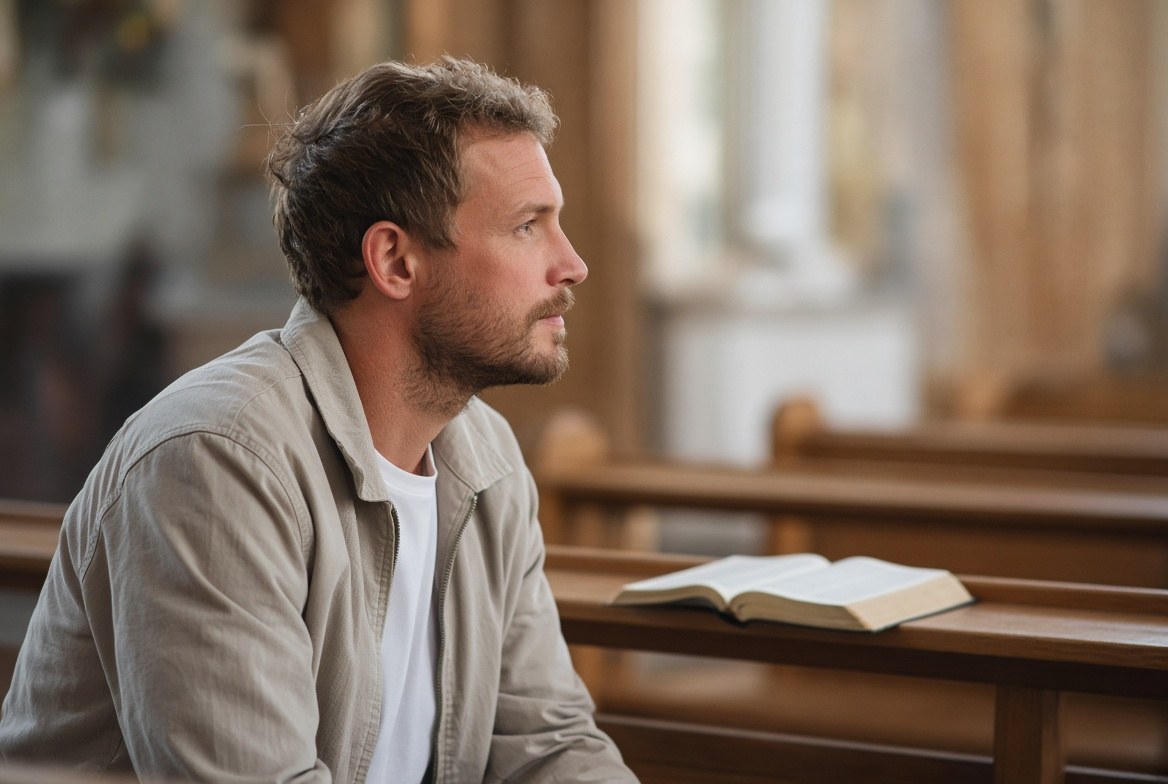
The guys most likely to call themselves porn addicts aren’t always the guys watching the most porn. A lot of the time, they’re the ones who were taught hardest that it’s wrong.
Researchers keep finding the same pattern: the “addict” label tends to track what a man believes about porn more than how much of it he watches. A lot of that comes down to what he was taught about sex before he ever had a say in it. I’m not here to trash anybody’s faith, and I’ll say that plainly up front. But the research is consistent enough that it deserves a straight conversation, especially if you’re the guy feeling sick about it afterward.
The finding that keeps showing up
Psychologist Joshua Grubbs and his colleagues have spent years asking why some people see themselves as porn addicts while others with similar habits don’t. In one of their early studies, they surveyed roughly 636 people across three samples, two of them college students, and measured religious belief, moral disapproval of porn, how often people watched, and whether they felt addicted. Strong religious beliefs and strong moral disapproval predicted feeling addicted. How often someone actually watched did not. As Grubbs put it, “We were surprised that the amount of viewing did not impact the perception of addiction, but strong moral beliefs did.”
A fair note on that one. It measured perceived addiction, which isn’t a clinical diagnosis. It was based on self-reports, it can’t show cause and effect, and the samples skewed young, Christian and white. So treat it as a strong clue and not a verdict.
The follow-up work gives a fuller picture. In a nationally representative sample of about 2,075 American adult internet users, roughly 11 percent of men and 3 percent of women agreed with the statement “I am addicted to pornography.” Greater religiousness was linked to stronger feelings of addiction. So was greater moral conflict about porn. And so was simply using more of it, which matters, because it means the story isn’t “shame is everything and frequency is nothing.” Both are in play. The point is that belief adds its own weight on top of the behavior.
A separate team ran into the same pattern. A survey of 686 unmarried adults found that religious participants were more likely to believe their porn use was addictive, even at the same level of actual use. The part that stuck with me was what the label did next. Actual use alone rarely produced anxiety about relationships. Feeling like an addict did. People who saw themselves that way were more likely to hide their use from partners and to agree with statements like “I feel unworthy to go on dates because of my pornography use.” The researcher, Nathan Leonhardt, summed it up this way: “a shaming culture surrounding pornography can be problematic.”
Why would belief change the label?
Researchers call it moral incongruence, which is a fancy phrase for doing something you believe is wrong. Your behavior points one direction and your values point the other, and the friction between them feels awful. Of course it does. Anybody would feel like garbage doing something they’ve condemned that hard while continuing to do it.
Dr. David Ley, clinical psychologist and sex therapist, has argued this for years. In a 2016 piece on religion and porn, he wrote, “The problem here is not the porn.” His view is that the distress comes from the clash between religious sexual values and the choice to use porn, and that therapists should be working on the values, the shame and the sense of addiction, not only the porn use. That’s his clinical read, and he makes some claims in that piece without citing studies, so weigh it as an informed opinion. But it fits the research above.
Here’s the part I find hardest to wave away. If porn were a straight-up chemical addiction, belief wouldn’t matter much. Heroin doesn’t check your church attendance. Withdrawal doesn’t care what you were raised to believe. The label, though, tracks theology, shame and upbringing. That’s how moral conflict behaves, not how a brain disease behaves.
There’s a second thing going on, too, and it might be the cruelest one. The standard advice in a lot of recovery programs, faith-based or not, is to grit your way through it and never slip. One study of Israeli adolescents, religious and secular, found that religious teens suppressed sexual thoughts more, and that suppressing them predicted more preoccupation with those thoughts and lower well-being. Sex researcher Justin Lehmiller, writing about the study, put the takeaway simply: “suppressing a given thought just makes us think about it more in the long run.” If you’ve ever been told not to think about a white bear, you already know how this goes.
When the community hands out the diagnosis
This isn’t only a story about individual guys. Some of the pushback is coming from inside religious communities.
In 2016, the Mormon Mental Health Association, a group of Latter-day Saint mental health professionals, put out a position statement saying that “sex addiction” and “pornography addiction” are not classified as psychiatric disorders. It declined to endorse sex addiction treatment models, and it said that behavior labeled that way “usually has more to do with living certain religious or conservative values and standards than diagnosable criteria.” Read that again. Professionals inside the culture are warning their own community that the addiction label is being used for ordinary behavior that conflicts with religious standards.
Dr. Ley goes a step further in his 2016 piece, suggesting that framing porn as a biological addiction can let religious leaders hand a guy off to “treatment” instead of having a harder conversation about morality. He doesn’t cite research for that, so file it as his professional take. But it raises a question worth asking whenever a church program, a counselor or an app opens with “you’re an addict” before they know a thing about you.
Does this look the same for every religious guy?
Not quite, and one study shows why the question is worth asking. Sociologists Samuel Perry and Cyrus Schleifer dug into 43 years of the General Social Survey, a long-running national poll of American adults, using answers from 20,620 people. They wanted to see how race, gender and religion shape porn viewing over time. A few limits first. The survey’s question is dated (“Have you seen an X-rated movie in the last year?”), so it says nothing about how often anyone watches or whether they watch online. And it only allowed a black versus white comparison, so Latino, Asian and other groups aren’t covered.
Within those limits, here’s what showed up:
- Black Americans reported more viewing than white Americans overall. Pooled across all the years, it was about 35 percent versus 26 percent, and black men had the highest rate of any race and gender group.
- The trends moved differently. Viewing climbed for black men and women over the decades, while white women stayed roughly flat.
- Religion didn’t work the same way in every group. White men who attended worship at least monthly stayed roughly flat in their viewing across the decades. For black men, black women and white women, regular attendance didn’t change the trend. In the authors’ words, monthly worship attendance “was a moderating factor for White men but not Black men.”
Perry and Schleifer’s explanation is cultural. They argue that “Pornography has never been a key moral issue for the Black community,” while white Americans tend to tie religious commitment to sexual behavior. They also say they couldn’t test that explanation directly, so it’s an argument, not a result.
Keep the fine print in mind, too. This study measured whether people watched, not whether they felt like addicts, so it can’t tell us how black and white religious men compare on that. I haven’t found a study that does. But it does suggest that the moral-conflict story isn’t a universal law of religion. It may depend on how much a particular community treats porn as a central moral failing. If so, a good chunk of the shame behind the “addict” label is something communities hand out, not something built into belief. Treat that as a hypothesis worth chasing, not a conclusion.
One more piece of context, and it’s about geography. In 2017, Pew Research Center surveyed 15 countries in Western Europe and found that most people there still call themselves Christian, but few regularly go to church. In every country except Italy, Christians who attend rarely, a few times a year or less, outnumbered the ones who attend at least monthly. Compare that with the United States, where 68 percent of American Christians said religion is very important in their lives, against a median of 14 percent of Western European Christians. A man can be “Catholic” on paper in much of Europe and mean something very different by it than a churchgoing evangelical in the American South does. That matters here because most of the research above comes from the United States, where faith tends to be a bigger part of daily life. It’s another hint that the shame behind the “addict” label may have more to do with how a community lives its faith than with the word “religious.” Pew didn’t measure porn use or addiction, so take this as background, not proof.
This isn’t a knock on faith
Grubbs has been careful about this, and so should we be. When his team published a later paper, he said they are “not suggesting that people need to change their moral or religious beliefs.” Plenty of religious people hold their values and their sexuality together without it tearing them apart. One more caution: most of these studies sampled Christians in the United States, plus Israeli teens in one case, so I wouldn’t stretch the findings across every faith without more research.
What the research does suggest is that the fix depends on where your distress is coming from. If you’ve looked at your beliefs in the calm light of day and they’re truly yours, then bringing your behavior in line with them is a legitimate path. If you discover that “porn is evil” is a hand-me-down you’ve never examined, you’re allowed to examine it. And if you land somewhere in the middle, there are therapists who can help you hold both without the shame spiral.
None of this means nobody struggles. Some men, religious or not, really do feel out of control. The World Health Organization lists compulsive sexual behavior disorder in the International Classification of Diseases, 11th Revision (ICD-11), filed under impulse control rather than addiction. If that’s you, get real help. But “I feel awful about this” and “I have a disease” are two different sentences, and the first one can be true without the second.
If you’re the guy in the pew
A few things I’d tell a friend.
- Ask whose rule this is. Is the belief something you’ve examined and chosen, or something you absorbed before you could argue with it? Neither answer makes you a bad guy. You just deserve to know which one it is.
- Run the two-question test. Is this costing me something I actually value right now, and do I keep doing it anyway? If the honest answer is “no” and “no,” you may be dealing with shame, not a problem. My free Habit vs. Problem Test takes about two minutes, and Am I a Porn Addict? explains why a late-night quiz is a poor way to find out.
- Be careful with a diagnosis-first program. If the first thing out of anyone’s mouth is “addict,” ask what they believe about porn and about faith before you sign up for anything. A certified sex therapist, with credentials from the American Association of Sexuality Educators, Counselors and Therapists (AASECT) at aasect.org, is a good place to start, and some work comfortably with clients who are religious.
- Don’t grind out a streak. Counting days and swearing off forever tends to turn one slip into a catastrophe and keeps the thing at the center of your mind. The suppression research above is a big reason why.
In my book, Chapter 5, “Not the Behavior. The Belief.,” walks through this research in more detail, and Chapter 10, “A Plan That Isn’t a 90-Day Reboot,” lays out what to do instead of grinding out a streak. If you’ve been carrying a label you were handed, you can find it here.
Get the book and the bonuses here.
The short version
Religious guys don’t appear to watch more porn, but they’re more likely to call themselves addicts, and the label seems to track belief and shame more than behavior. How that plays out looks different from one community to another. That doesn’t make faith the enemy. It means the most useful question isn’t “how do I fix my addiction?” It’s “where is this distress actually coming from?”
This post is general education, not medical or mental health advice.
Sources
- Grubbs, J. B., Exline, J. J., Pargament, K. I., Hook, J. N., & Carlisle, R. D. “Transgression as Addiction: Religiosity and Moral Disapproval as Predictors of Perceived Addiction to Pornography.” Archives of Sexual Behavior 44, no. 1 (2015): 125-136. Press summary.
- Grubbs, J. B., Kraus, S. W., & Perry, S. L. “Self-Reported Addiction to Pornography in a Nationally Representative Sample: The Roles of Use Habits, Religiousness, and Moral Incongruence.” Journal of Behavioral Addictions 8, no. 1 (2019): 88-93.
- Grubbs, J. B., Perry, S. L., Kraus, S. W., Lewczuk, K., & Gola, M. “Moral Incongruence and Compulsive Sexual Behavior: Results From Cross-Sectional Interactions and Parallel Growth Curve Analyses.” Journal of Abnormal Psychology (2020). Press summary.
- Leonhardt, N. D., Willoughby, B. J., & Young-Petersen, B. “Damaged Goods: Perception of Pornography Addiction as a Mediator Between Religiosity and Relationship Anxiety Surrounding Pornography Use.” Journal of Sex Research 55, no. 3 (2018): 357-368. PsyPost summary.
- Efrati, Y. “God, I Can’t Stop Thinking About Sex! The Rebound Effect in Unsuccessful Suppression of Sexual Thoughts Among Religious Adolescents.” Journal of Sex Research 56, no. 2 (2019): 146-155. Discussed in Lehmiller, J. J. “There’s Just One Problem With Suppressing Sexual Thoughts: It Doesn’t Work.” Sex and Psychology, June 18, 2018.
- Perry, S. L., & Schleifer, C. “Race and Trends in Pornography Viewership, 1973-2016: Examining the Moderating Roles of Gender and Religion.” Journal of Sex Research 56, no. 1 (2019): 62-73.
- Pew Research Center. “Being Christian in Western Europe.” May 29, 2018.
- Ley, D. J. “Porn vs. Religion.” Psychology Today, June 8, 2016.
- Mormon Mental Health Association. “Position on Sex Addiction and Porn Addiction.” March 16, 2016.
- Wegner, D. M., Schneider, D. J., Carter, S. R., & White, T. L. “Paradoxical Effects of Thought Suppression.” Journal of Personality and Social Psychology 53, no. 1 (1987): 5-13.
- American Association of Sexuality Educators, Counselors and Therapists (AASECT). Find a certified provider.
Habit or problem? Find out in two minutes.
Take the free Habit vs. Problem Test and read Chapter 1 of No More Porn Shame in full. No card required.
Get the Free Test & Chapter 1 →
Trey Lyon is a sex educator and the author of No More Porn Shame. He's not a therapist, and nothing here is medical advice. If something is really costing you, talk to a certified sex therapist.