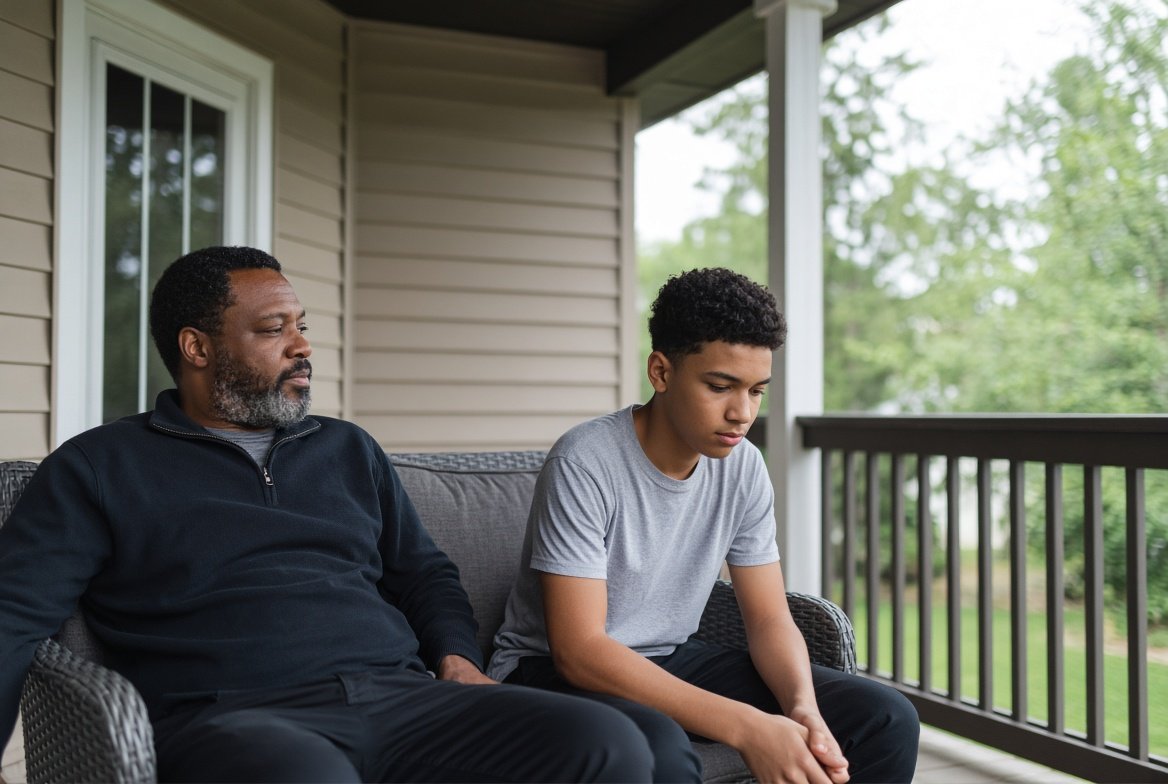
One widely reported survey put the average age kids first see porn at twelve. (I’ll get to why I’d hold that number loosely.) Parents, it turns out, tend to underestimate how much their kids have actually seen.
Meanwhile, plenty of families handle sex on screen the same way: a love scene starts, somebody suddenly needs a snack, and everyone stares at the wall until it’s over. For a lot of kids, that silence is most of their sex education.
If you like sex, and you don’t think porn is the villain it’s made out to be, you probably still feel that freeze when your own kid is involved. Fair enough. Being relaxed about adult sex doesn’t automatically make a person relaxed about explaining it to a fourteen-year-old. This post is for you anyway. No lecture about the evils of porn is coming, and no guilt trip about what your kid may or may not have already seen.
Your kid has probably seen more than you think
Here’s the part that surprises parents. A national study of 614 parent and teenager pairs in the United States, published in 2023, found that parents consistently underestimated how much porn their kids had seen and how much they’d picked up from it. The teens averaged about sixteen. Parents guessed low about both sons and daughters, and the gap was bigger for sons.
A few things that study did and didn’t show. It was a survey, so it tells us what teens reported and what parents guessed. It doesn’t tell us whether the porn did anything to anyone, good or bad. What it does tell us is that a lot of us are working from a rosier picture than the one our kids are actually living in.
Other numbers float around. A Common Sense Media survey, reported in the news in early 2023, put the average age of first exposure at twelve, with about 15 percent seeing it at ten or younger, and more than half saying their first look was an accident. Those are plausible figures. I’d still hold them loosely, because the news coverage didn’t include the sample size or methods. The same coverage claimed that 84 percent of the porn kids see shows violence, which is a bigger claim than I’d repeat without seeing how it was measured. Even the Common Sense Media researcher quoted in a 2021 news feature said that solid research on tweens and porn is thin and that many studies have shaky methods.
So here’s my read: kids see it, earlier than most parents think, and nobody knows precisely how much or what it does. That’s not a reason to panic. It’s a reason to talk.
Why the research is such a mess
You’ll find studies linking teens and porn to all kinds of bad outcomes, aggression and unhealthy attitudes toward sex among them. Before anybody panics over a headline, there’s a problem running underneath most of that work.
While I was writing this post, I messaged Dr. David Ley, the clinical psychologist and sex therapist I cite throughout the book, and asked what he makes of the research on kids and porn. These are his words from that exchange, shared with his permission. He put it bluntly. The link between kids and porn, he told me, is “hopelessly confounded with social and parenting issues.” His read is that kids raised by authoritarian or very conservative parents are more likely to end up looking at porn and picking up bad lessons from it, because those parents often don’t teach or model healthy sexuality. Teens who are already delinquent are more likely to watch porn and to have an unhealthy sexuality, because they’re delinquent. And kids who treat porn as a realistic picture of sex tend to learn the wrong things from it, because nobody ever showed them what the real thing looks like.
“So yes, there are and can be links to negative effects,” he said, “but the porn isn’t in a vacuum.”
He added one more point that I think matters. According to Dr. Ley, lesbian, gay, bisexual, transgender and queer (LGBTQ) youth “overwhelmingly report positive experiences with porn,” because it lets them see sexual depictions that match their orientation. Think about a kid in a small town who has never seen anyone like himself on screen or in a classroom. And the teens he considers most “at risk,” in his words, are “white teen males growing up in conservative areas who are told they shouldn’t have immoral sexual interests.” That lines up with the pattern in the book’s chapter on belief and shame: the distress seems to come less from the porn than from being taught that wanting it makes you a bad person.
Two notes on all that. It’s Dr. Ley’s professional read, offered in a conversation and not a citation to a particular study, so treat it as an informed opinion. That goes double for the point about LGBTQ youth, where he didn’t point to specific research and I haven’t verified the numbers myself. And “confounded” is a real, well-known problem in this kind of research, which usually can’t tell you whether the porn caused something or whether the same home, the same peer group or the same missing education explains both. It cuts the other way too. It doesn’t prove porn does no harm to a young person. It just means that “kid watched porn, kid had problems” isn’t the whole story, and that the part you can actually change is the home, the information and the relationship.
The shame is the part you can control
Dr. Ley put the stakes pretty simply in that earlier news feature: “not talking about it sets up kids for unfortunate lessons.” Porn mostly leaves out consent, negotiation and basic respect. If you don’t fill those in, something else will, and it’s rarely a better teacher than you.
Sex educator Marty Klein goes further. His position is that “unless kids are told that they’re bad or endangered if they stumble onto porn, seeing it won’t hurt them.” I like that line, and I’d add a note of caution. Klein doesn’t cite studies for it. It’s a seasoned professional’s judgment, not a settled finding, and I wouldn’t tell you the research proves it. What it does is point at something every parent controls: how you react the first time your kid says “I saw something online.”
React like a smoke alarm and you teach them to hide. React like a person and you teach them you’re safe to bring things to.
Not everyone agrees, and that’s fine
There’s a fair opposing view, and it deserves a straight hearing. Boston University’s Emily Rothman, who researches this, says, “We need to do more to prevent youth from viewing sexually explicit media.” Plenty of parents feel the same, and wanting to keep a nine-year-old away from adult content isn’t shame. It’s parenting. Even Rothman, though, agrees kids will see it anyway and need to be taught how porn differs from real sex.
You can believe adults should be free to enjoy porn and also believe a ten-year-old shouldn’t be the audience. Those two ideas fit together fine. The line isn’t “porn is bad.” The line is “this was made for adults, like a lot of things.”
How to actually start
Klein’s most useful reframe is that there’s no single big “Sex Talk.” He calls it a conversation that lasts 15 or 20 years, and the porn part comes after a long run of smaller ones about bodies, puberty, crushes, pressure and decisions. If you’ve never said the word “vulva” or “penis” out loud at home, start there, years before porn enters the picture.
Some things that tend to help, pulled from Klein, therapist Joe Kort and the experts in that 2021 feature:
- Say you’re embarrassed, then talk anyway. Klein’s version: if you’re embarrassed to talk to your kids about sex or porn, say “I’m embarrassed.” Then keep going. Kids tend to respect that more than a stiff, rehearsed speech.
- Ask before you tell. “What have you heard about porn?” or “Have you seen anything online that confused you?” Listen first. Kort recommends short talks, not lectures, and calm answers that don’t judge, so they keep coming back.
- Pick the setting. One on one, private, low pressure. In the car works for plenty of families because nobody has to make eye contact.
- Explain what porn is. It’s made for adults. It’s performance, with lighting, editing and plenty that happens off camera. It isn’t a how-to video, and the bodies and scenarios are not typical.
- Say what porn leaves out. Consent, talking about what you want, checking in, stopping when someone says stop, condoms. This is the part your kid can’t learn from the video itself.
- Be honest that adults feel differently. Some adults enjoy porn. Some object to it. Your kid will meet both kinds. You can tell them where your family lands without making either side the enemy.
- Cover sexting. Klein suggests a non-punitive rule: if someone sends them a sexual image they didn’t ask for, they can come to you without getting in trouble.
- Keep it going. One talk won’t do it. Think of it as thousands of tiny ones.
If you want a book-length version, Klein recommends Dr. Debby Herbenick’s Yes, Your Kid: What Parents Need to Know About Today’s Teens and Sex, which covers porn, sexting, hookups and consent along with relationships and self-respect.
What to say when your kid admits they’ve seen it
This is the moment that matters most, so let’s rehearse it. Your teenager says, in an offhand mumble, that they’ve watched porn. Or you find out another way.
You don’t need a speech. Try some version of this: “Thanks for telling me. You’re not in trouble. Curiosity about sex is normal. Can we talk about what you saw, and what it did or didn’t teach you?” Kelman, the therapist in the 2021 feature, put it well: “There is no shame in natural growth and curiosity.”
That sentence is a good one to say to yourself, too, if you’re the parent who’s quietly panicking.
The movie-night moment
Back to that sex scene on screen from the top of this post. I wrote about this online recently, and I’ll say it here the way I said it there. If I were a parent and kept catching my kids leaving the room every time a mild, nearly family-friendly love scene came on, I’d take it as a signal. Not proof that I’d failed, but a nudge to look at what my kids have picked up about sex from watching me. If a kid already seems to be showing a developing sense of sexual shame, the home they grew up in is one of the first places worth looking.
Then I’d get curious, not defensive. Something like: “That got awkward for you, huh? What’s weird about watching that with me in the room? Would you leave if I wasn’t here?” Underneath it is the real question. What is it about me that makes my kid not want me to see them watching this?
A fair caveat, since this is my opinion and not a research finding. Plain teenage mortification is a real thing, and plenty of kids who grew up in open, relaxed homes still want to melt into the couch when a love scene starts. Both can be true at once, and you won’t know which one you’re looking at until you ask. So skip the teasing, skip the pretending, and ask. You might get an eye roll. You might get a real answer. Either one tells your kid that sex isn’t a subject that makes the room go quiet.
What about filters and age checks?
I cover this in my book, though I should be upfront that it isn’t a parenting book. Chapter 4 looks at why porn-filtering software and age-verification laws mostly fail to do what they promise. Teens get around filters quickly, and the book’s reading of the research is that open conversations about sexuality tend to protect better than technical barriers do. That’s my take on the evidence, not a guarantee. Filters can still have a place for younger kids, and plenty of families use them as one layer, not the whole plan. The Common Sense Media researcher quoted earlier said much the same thing: kids find ways to get to it even when parents use blockers.
If you and your co-parent don’t see porn the same way, that’s its own conversation. The partner chapter and the bonus worksheet in the book were written for couples who disagree about porn, and they may help you two get on the same page before you talk to your kid.
Get the book and the bonuses here.
When to bring in help
Most of this is ordinary parenting. A few situations aren’t. If your child is being pressured, threatened or exploited online, or you think someone is targeting them, contact the appropriate authorities and a professional right away. If you want help talking through your own comfort with the topic, or a family disagreement, look for a certified sex therapist. The credential to look for comes from the American Association of Sexuality Educators, Counselors and Therapists (AASECT), at aasect.org. Ask what they believe about porn before you book.
The short version
Kids see porn earlier and more often than most parents guess. Shame is the one ingredient you can leave out. Keep the conversations short, keep them going, tell the truth about what porn is and isn’t, and when your kid squirms, get curious instead of quiet.
This post is general education, not parenting, medical or mental health advice.
Sources
- Wright, P. J., Herbenick, D., Paul, B., & Tokunaga, R. S. “U.S. Parents Underestimate Their Children’s Pornography Use and Learning.” Archives of Sexual Behavior 52, no. 1 (2023): 373-383.
- “After Billie Eilish talks about porn, experts urge parents and kids to have straight talk about sex.” Cable News Network (CNN) Health, via KRDO, December 23, 2021.
- “Common Sense Media survey finds average age kids were exposed to pornography was 12 years old.” ClickOnDetroit, January 10, 2023 (news report; methodology not included).
- Klein, M. “Parents: How to Talk to Your Kids About Porn.” martyklein.com, April 28, 2017.
- Klein, M. “Parents, Porn Isn’t the Problem.” martyklein.com.
- Klein, M. “Father’s Day Gift: Sex Ed Help.” martyklein.com.
- Klein, M. “Herbenick Book: Yes, Your Kid.” martyklein.com (review of Herbenick, D., Yes, Your Kid: What Parents Need to Know About Today’s Teens and Sex).
- Kort, J. “Kids Watching Porn Is Not the Problem.” joekort.com (statistics in the original are unsourced and are not used here).
- American Association of Sexuality Educators, Counselors and Therapists (AASECT). Find a certified provider.
Habit or problem? Find out in two minutes.
Take the free Habit vs. Problem Test and read Chapter 1 of No More Porn Shame in full. No card required.
Get the Free Test & Chapter 1 →
Trey Lyon is a sex educator and the author of No More Porn Shame. He's not a therapist, and nothing here is medical advice. If something is really costing you, talk to a certified sex therapist.