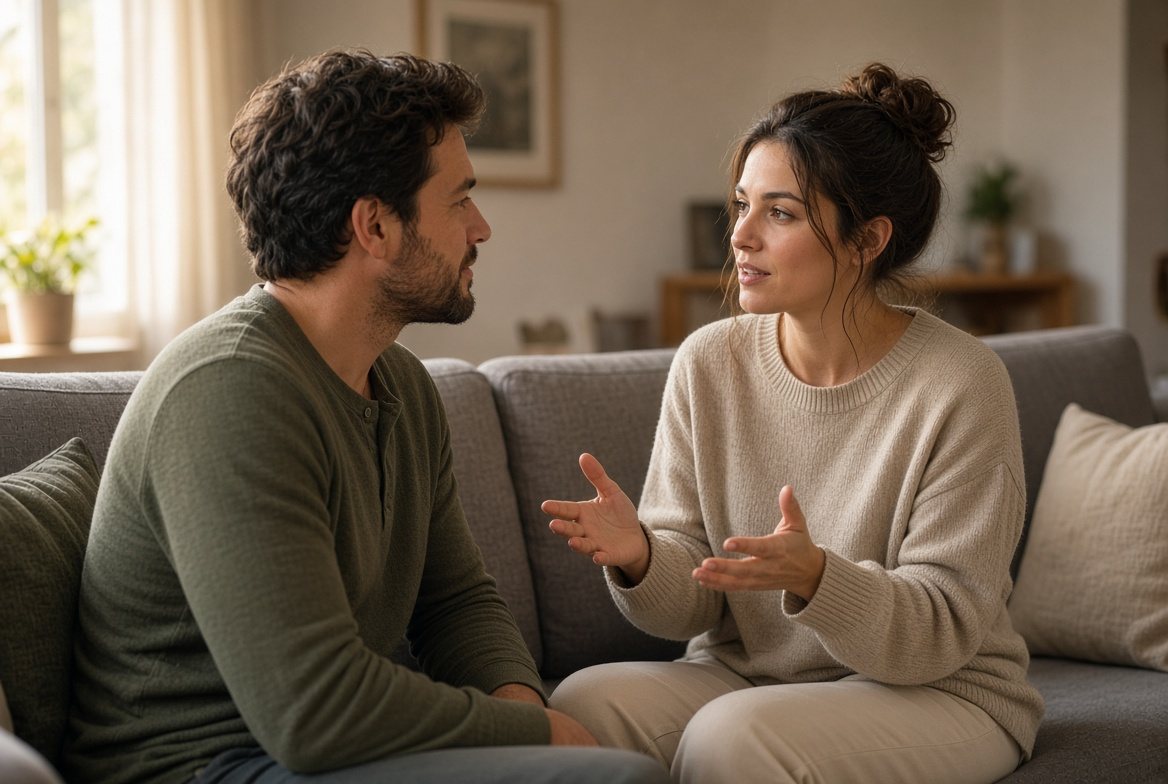
You can both be right about different things. Your partner’s hurt can be completely real, and the story they’ve attached to it can still be wrong. Hold both at once and the whole conversation changes.
Plenty of these talks don’t start there. They start calm and end with somebody saying “addiction,” somebody else saying “you’re being dramatic,” and the two of you sleeping on opposite edges of the bed.
I wrote a full chapter on this in my book, and there’s a bonus worksheet built around it. I’m not going to hand you all of it here. But I’ll give you enough to have a better conversation tonight than the last one.
First, which kind of “anti-porn” are you dealing with?
Not every objection is the same, and mixing them up is how fights go in circles.
- Hurt. They feel insecure, lied to, or compared to strangers on a screen. This is the most common one, and the most fixable.
- Programming. They’ve soaked up the same “porn destroys relationships, a real partner would never need it” messaging that everybody around us has. Plenty of their alarm is inherited, the same way plenty of men’s shame is.
- Values. Porn clashes with their religious or moral convictions, period. That isn’t a misunderstanding you can fix with a study. It’s a values difference, and it deserves to be treated like one.
Most people are a blend. Listening for which one is driving this week’s fight tells you what to say next.
What’s usually underneath
When partners describe what actually bothers them, the porn often isn’t the root. A few things come up again and again:
- “I’m not enough.” The fear that you’d rather have the people on the screen. Almost always false. Still painful.
- The secrecy. For a lot of people the hiding stings more than the watching. “What else don’t I know?” is a much bigger question than “why do you watch?”
- Assumptions nobody said out loud. You each carried a private idea of what the relationship allowed, and you only found out they didn’t match when they collided.
- The scary story. Sometimes the unspoken worry is bigger: that porn makes men colder, or even dangerous. That deserves a real answer instead of a defensive one, and the book takes it on directly.
Studies on porn and relationships don’t all agree, and most of them can’t tell cause from effect. But one thing keeps showing up: how a couple handles porn, in the open or behind each other’s backs, seems to matter more than the viewing itself. One study across four samples of couples found that partners who watched together reported higher relationship and sexual satisfaction than those who didn’t. The title of that paper says it all: But What’s Your Partner Up to? It’s an association, and it isn’t right for everyone, so don’t go springing a movie night on anybody.
Attitudes seem to do a lot of the work, too. Sex researcher Justin Lehmiller has written up a study of more than 3,000 cohabiting couples in the United States where how each partner felt about porn changed what it did to the relationship. When a person accepted porn, a partner’s use had a weaker link to lower satisfaction. When they didn’t, the link was stronger. It’s correlational, so it can’t say which came first, but it fits what you’ve probably seen: the same browser history lands very differently depending on the beliefs the person brings to it.
And to be fair to your partner, not every finding is cheerful. In a 35-day daily-diary study of 217 couples, porn use didn’t predict whether relationship satisfaction went up or down over time. But on days the man used porn, his partner reported lower desire for sex. Lehmiller notes that could mean porn replaced sex, or that the partner sensed it and felt insecure or inadequate. Either way, your partner’s reaction isn’t always out of nowhere, and that’s worth knowing before you walk in.
Then there’s the label. A study of 686 adults found that thinking of yourself as a porn addict, more than how much porn people actually used, predicted anxiety about porn in their relationships. If your partner has handed you the “addict” label, or you’ve been wearing it yourself, that story may be doing more damage than the porn ever did. If you want to know where you actually stand, take the free two-minute Habit vs. Problem Test before you take this conversation anywhere.
Five moves for the first conversation
This isn’t the whole playbook. It’s the part that gets you through the door.
1. Pick your moment, and do your homework first. Not mid-argument. Not right after a discovery. Not five minutes before one of you leaves the house. Before you talk, work out at a calm moment why porn matters to you and what you actually value about sex and honesty. You don’t want to improvise that at 1am.
2. Start soft. Open with an invitation, not a verdict. Alexandra Solomon, a clinical psychologist who teaches in Northwestern University’s marriage and family therapy program, says couples talking about porn need to be “curious, not critical.” Her suggestion is to take turns telling each other the story of your relationship with porn, with one ground rule: you promise not to “use what you learn as ammo.” That’s a clinician’s advice and not a study result, but it’s hard to argue with. Ari Tuckman, a psychologist and certified sex therapist, lands in the same place: talk “with curiosity and honesty,” and remember that a calm reaction to an honest disclosure helps cut down the guilt and shame that keep secrets going. Try something like: “I want us to actually hear each other on this. Is now an okay time?”
3. Aim at the feeling, not the debate. If you argue about porn, you’ll argue about porn forever. Ask about the thing underneath: whether they feel wanted, whether they feel lied to, what they were afraid this meant. Certified sex therapist Marty Klein, who has spent decades hearing these complaints, says that when partners say they hate porn they’re usually “talking about relationships, character, power, integrity, and communication.” His advice to the partner who objects is “stop arguing about the porn” and say what they actually feel. It works just as well in reverse.
4. Validate without signing a false confession. “Your feelings make sense” and “I’m an addict” are not the same sentence. You can say “I hear that this made you feel insecure, and I don’t want you to feel that way” without adding a diagnosis you don’t have. Give them the empathy. Don’t give them a lie about your own brain.
5. Ask one clarifying question. Try this: “If you knew my porn use had nothing to do with how much I love you or how attracted I am to you, would it still bother you?” Either answer tells you something. If it’s no, you’re really talking about reassurance and security. If it’s yes, there’s a value or a boundary under all this worth naming out loud, instead of guessing at it.
So is it cheating?
It depends, and anyone who gives you a flat yes or no is selling something. Cheating is the breaking of an agreement. The trouble is that most couples never made one. You didn’t think you were crossing a line. They felt like you did. Nobody’s lying about their experience, you just never negotiated the terms. The fix is the conversation you skipped.
What not to do
- Don’t hit them with statistics. Data supports the conversation. It doesn’t replace it.
- Don’t say “you’re being crazy.” It’s a fast way to make someone feel more alone with the hurt.
- Don’t grovel. Confessing to a disease you don’t have buys you a day of peace and solves nothing.
- Don’t hide it and hope. If there’s been secrecy, own that part. It’s usually the part that actually broke something.
- Don’t try to settle everything in one sitting. “Let’s keep talking about this” is a complete sentence. Tuckman describes the healthy version as ongoing discussions, not a single showdown.
What’s in the book (and what I’m holding back)
Everything above gets you through the door. The hard part comes a few minutes later, when your partner says something that stings and your brain goes straight into defense mode. That’s where most of these conversations are lost, and it’s exactly what Chapter 8 of No More Porn Shame and the bonus, How to Talk to a Partner Who’s Worried About Your Porn Use, were written for.
Here’s what’s waiting in there that I’m not handing out for free:
- What to say first, before you respond to a single concern your partner raises. There’s an order to this, and most guys get it backwards. They lead with the facts, and your partner hears a debate opponent instead of a partner. The book shows you how to take the heat out of the room first, so the facts have somewhere to land.
- Twelve “I hear you” lines, ready to go. Short, believable things you can reach for while your pulse is up and your mind is blank.
- Word-for-word answers to the six lines you’re most likely to hear. “You’re addicted.” “If you loved me, you wouldn’t need it.” “It’s basically cheating.” “Real women can’t compete with that.” “It’s going to make you see women as objects.” “Just stop, then, if it’s no big deal.” Every one has a reply that doesn’t cave, doesn’t counterattack, and doesn’t sound like a lecture.
- The empathy line that backfires. There’s a phrase most of us reach for because it feels like the safe, caring choice, and it often lands as the opposite. The book tells you what it is, what to say instead, and the two words that turn an honest conversation into an accusation.
- How to let them be right without lying. It’s a real skill, and it’s the difference between disarming your partner and manipulating them. They can tell which one you’re doing.
- The question your partner may be afraid to say out loud. Sometimes what’s underneath a browser-history fight is a much scarier worry. The book gives you the facts for answering it calmly, without getting defensive.
- A second question that changes what the fight is really about. Most couples never say this one out loud. Once it’s on the table, the whole conversation tends to shift.
- A page written to your partner. You can hand it over, so they hear part of this directly instead of filtered through you mid-argument.
- How to land on an agreement you’ve both actually signed. Plus how to tell when the gap is a values difference that’s bigger than porn.
- A worksheet for before you open your mouth. It’s the companion Sexual Values Checklist bonus, and it’s built to get your own head straight so you aren’t improvising at 1am.
None of this is a magic spell, and the book says so. It takes patience, a few conversations, and leaving your ego at the door. But it gives you something better to say than “it’s not a big deal.”
I can give you the five moves in a blog post. What I can’t do here is give you the exact words for the moment your partner says the thing you didn’t see coming. That’s what the scripts are for. You can walk into this conversation with a plan or wing it, and you already know how winging it went last time.
Get the book and the bonuses here.
If you want the science behind the “addiction” accusation first, read Am I a Porn Addict? Why That 1am Quiz Got It Wrong.
When talking isn’t enough
Sometimes you do everything right and it turns out the gap is bigger than porn. Maybe it’s a values difference that won’t budge. Maybe the reaction is tangled up with an old betrayal. That’s worth knowing, and it’s better found out than papered over.
That’s when a third person helps. Look for a certified sex therapist, and for credentials from the American Association of Sexuality Educators, Counselors and Therapists (AASECT) at aasect.org. Before you book, ask what they believe about porn. A certified sex therapist writing in Psychology Today recommends exactly that, because the answer tells you a lot about whether they’ll help or just hand you a new set of chains.
The short version
Their hurt is real. The addiction label isn’t. You don’t have to pick between respecting your partner and respecting yourself, and the guys who think they do are the ones who end up groveling or resenting. There’s a third option, and it starts with a calm moment and an honest first sentence.
This post is general education, not relationship or mental health advice.
Sources
- Solomon, A. H. “How to Talk with Your Partner about Porn, and Why You Should.” Psychology Today, May 13, 2020.
- Kohut, T., Dobson, K. A., Balzarini, R. N., Rogge, R. D., Shaw, A. M., McNulty, J. K., Russell, V. M., Fisher, W. A., & Campbell, L. “But What’s Your Partner Up to? Associations Between Relationship Quality and Pornography Use Depend on Contextual Patterns of Use Within the Couple.” Frontiers in Psychology 12 (2021): 661347.
- Kohut, T., Fisher, W. A., & Campbell, L. “Perceived Effects of Pornography on the Couple Relationship: Initial Findings of Open-Ended, Participant-Informed, ‘Bottom-Up’ Research.” Archives of Sexual Behavior 46, no. 2 (2017): 585-602.
- Leonhardt, N. D., Willoughby, B. J., & Young-Petersen, B. “Damaged Goods: Perception of Pornography Addiction as a Mediator Between Religiosity and Relationship Anxiety Surrounding Pornography Use.” Journal of Sex Research 55, no. 3 (2018): 357-368.
- Klein, M. “What Women Tell Me They Hate About Porn.” martyklein.com.
- Fike, A. “What Women Actually Mean When They Say They Hate Porn” (interview with Marty Klein). Vice, 2026.
- Tuckman, A. “Agreeing About Porn.” Psychology Today, October 19, 2017.
- Lehmiller, J. J. “How Is Porn Use Linked to Relationship Satisfaction? It’s Complicated.” Sex and Psychology, April 2, 2018 (summarizing a study of 3,313 couples published in the Journal of Sex Research).
- Lehmiller, J. J. “Is There a Link Between Porn Use and Relationship Satisfaction? Actually, No.” Sex and Psychology, September 16, 2020 (summarizing a daily-diary study of 217 couples).
- Ley, D. J. “Is Watching Pornography a Form of Cheating? It Depends.” Psychology Today, February 2018.
- Cooper, S. “Is Porn Addiction Really a Disorder?” Psychology Today, January 26, 2021.
- American Association of Sexuality Educators, Counselors and Therapists (AASECT). “AASECT Position on Sex Addiction.”
Habit or problem? Find out in two minutes.
Take the free Habit vs. Problem Test and read Chapter 1 of No More Porn Shame in full. No card required.
Get the Free Test & Chapter 1 →
Trey Lyon is a sex educator and the author of No More Porn Shame. He's not a therapist, and nothing here is medical advice. If something is really costing you, talk to a certified sex therapist.